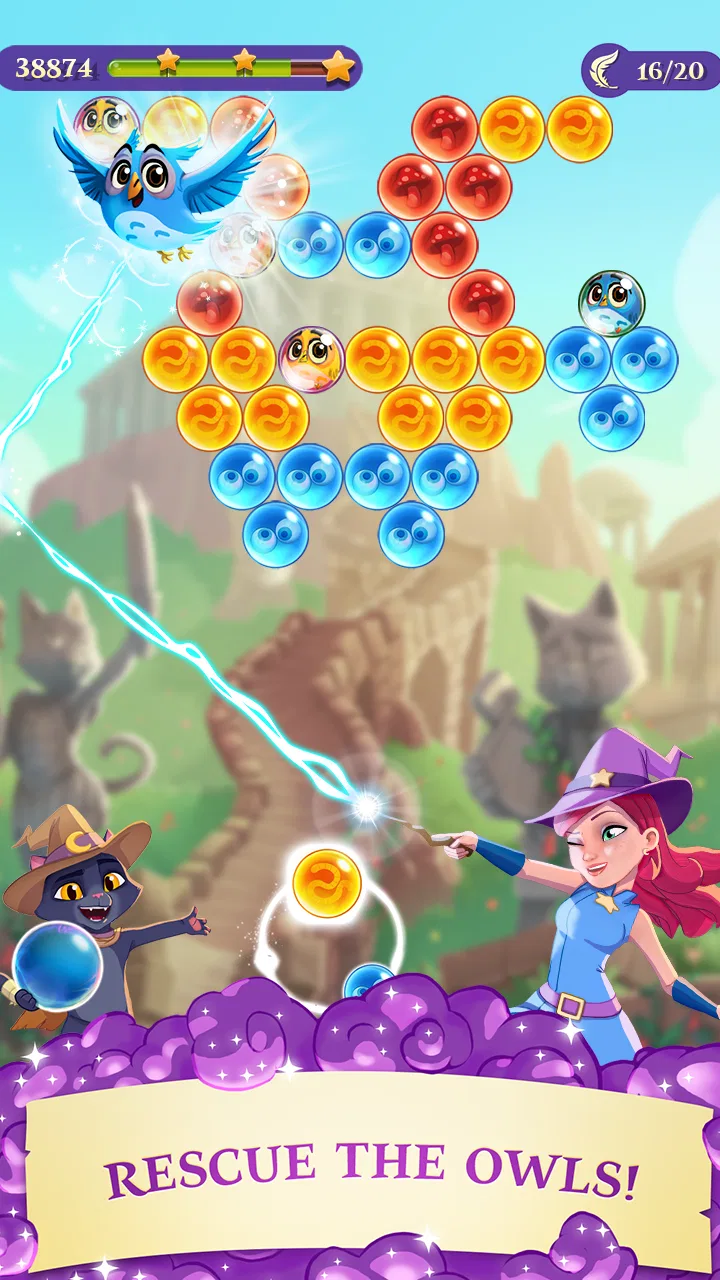
Bubble Witch 3 Saga
- 4.7
- Rating
- 100.00M
- Installs
- Free
- Price

 Analysis by App-foxy
I spent time with Bubble Witch 3 Saga as a casual puzzle game, and my first impression was that it understands exactly why bubble shooters remain easy to pick up. A level can fit into a short break, the controls are immediately readable, and the colorful presentation gives the game a friendly personality without asking me to learn a complicated rulebook. It is free to play, suitable for Everyone, and made by King, so it is clearly designed for a broad audience rather than a small group of specialist puzzle fans.
The important question is not whether the basic idea is familiar. It is whether this particular version gives me enough variety and control to keep returning without turning every session into a chore. My answer is mostly positive, with some reservations. The game feels best when I want a quick, focused challenge and can accept a progression system that may encourage patience or spending. It is less convincing when I want a completely relaxed experience with no pressure around limited attempts, difficult stages, or optional purchases.
How Bubble Witch 3 Saga feels in everyday play
I find the game works best when I treat each visit as a small puzzle session rather than a commitment to clear a long run of levels. A useful habit is to pause before a shot and ask what it will make possible next, especially when a board looks deceptively simple. From there, I’ll look at how a first-time player can get comfortable with the aiming and make an early success feel earned.
You May Also Like

 AccuWeather: Weather Radar
AccuWeather Review: A Quick, Clear Forecast for Everyday Decisions
For everyday plans, the best forecast is the one you can understand quickly. AccuWeather makes rain timing, radar, and local conditions easy to act on, with a few trade-offs.

 Hill Climb Racing
Why Hill Climb Racing Still Turns Crashes Into One More Run
A tiny car, a bumpy hill and one more upgrade: Hill Climb Racing keeps resurfacing because its simple chaos makes every near-miss feel personal.

 AliExpress - Shopping App
AliExpress Makes Global Shopping Feel Personal, but Shoppers Bear the Risk
AliExpress turns a global marketplace into a pocket-sized discovery engine. Its reach is useful, its shopping loop compelling, and its trade-offs easy to miss.

 Lords Mobile: Kingdom Wars
Lords Mobile Is a Kingdom-Building Routine, Not a Quick Match
A case-by-case verdict on the building, battles, device demands, and social commitments that make Lords Mobile rewarding for some players and exhausting for others.

 PDF Scanner app - TapScanner
TapScanner Makes Paperwork Easier to Capture, Check, and Share
TapScanner makes scanning with a phone feel less like a rescue operation and more like a dependable step in getting work done. Its capture tools are useful, though not flawless.

 Block Blast!
 Shows How Much a Puzzle Game Can Leave Out
A quiet grid game shows why puzzle players increasingly value instant clarity, repeatable skill and low-pressure play—and where the genre still needs to catch up.
More From Our News Desk
View All News


Quick starts and a pace that suits short sessions
The central action is straightforward: I aim and shoot colored bubbles, trying to create useful matches and clear the board. That simplicity is a strength because I can open the game after a long day and start playing almost immediately. I do not need to remember a complex control scheme, and the visual feedback makes it clear whether a shot helped or merely used up a valuable opportunity.
In terms of perceived speed, the game generally feels brisk during ordinary level play. The turns are short, so progress depends more on choosing a good angle than on waiting through long stretches of animation. That makes it a natural fit for a commute, a queue, or a few minutes before bed. I also like that the puzzle format creates a clean stopping point: finishing a level feels more satisfying than abandoning an endless match halfway through.
The pace changes when a board becomes difficult. A simple-looking arrangement can require several attempts because one early mistake affects every later shot. At that point, the game feels slower even if the controls remain responsive, because I spend more time studying the layout and deciding whether to take a safe shot or attempt a riskier bank. That extra thought is welcome for puzzle fans, although anyone expecting a purely mindless bubble shooter may find the later rhythm more demanding than the opening stages suggest.
One useful habit is to avoid firing immediately when a level begins. I first look for bubbles supporting a larger group or for a route that can remove several colors at once. The best shot is not always the one that clears the most visible bubbles. Sometimes it is the shot that opens space for the next two turns. This small change in approach makes the game feel more strategic and reduces the frustration of wasting a move on a visually satisfying but strategically weak hit.
What happens when the game gets busy
Bubble shooters are not graphically complex in the same way as a large action game, but the screen can still become busy when several bubble groups react in sequence. In my experience, the important performance question is whether the action remains easy to read while the board changes. Here, the bright colors and clear separation between objects help me follow the result of a shot, especially when several pieces disappear or fall together.
I would still avoid judging the game only by its first few minutes. Casual puzzle games often feel effortless at the start, then demand more concentration once the layouts become less forgiving. The heavier moments for the player are usually not about fast reflexes; they are about managing attention. I may need to track the current color, the next available option, the angle of a banked shot, and the consequences of removing a supporting section. That is where the game uses more mental energy than its cheerful appearance implies.
For a smoother session, I play with notifications and other distractions kept away from the screen. A bubble shooter does not need my full attention every second, but a short interruption can make me forget the plan for a carefully prepared shot. This is especially relevant on levels where the board is arranged around narrow openings. Taking a moment to inspect the path before touching the firing control is more effective than trying to recover from a rushed move.
Another practical tip is to treat the lower part of the board as a resource rather than a target. Clearing bubbles near the bottom may feel urgent, but a higher connection can sometimes remove an entire hanging section and create a much larger change. I found that looking upward for the supporting link often produces better results than repeatedly attacking whatever is closest to the shooter.
Reliability matters more than spectacle
Because each level is compact, a technical interruption would be especially annoying. I want the game to open cleanly, accept a shot when I make it, and preserve my progress when I leave. My overall impression is that the experience is dependable enough for its intended casual role, but I still recommend treating it like any mobile game: keep the operating system reasonably current, leave some storage available, and avoid running it in an already overloaded environment.
The current version is 10.14.2.0, and the minimum supported operating system is Android 6.0. That makes the game accessible to many older Android devices, although support on paper does not guarantee identical smoothness on every handset. A newer phone with more available memory will generally be a safer choice for people who dislike stutters or slow app switching, while an older device may still handle the puzzle itself well if it is not under heavy strain.
Recovery is one of the areas I pay attention to with a level-based game. If I have to stop in the middle of a session because a call arrives or the battery runs low, I want returning to the game to feel simple rather than confusing. The short format helps here because I can often finish a stage before switching away, but I would not deliberately close the app during an important sequence just to test how every interruption behaves. The sensible approach is to complete a level when possible and allow the game to settle before moving to another demanding app.
There is also a difference between a game being reliable and a game being free of friction. Bubble Witch 3 Saga can remain stable while still asking me to replay a challenging stage, wait for another opportunity, or consider an optional purchase. Those moments are part of the design experience, not necessarily technical failures. I found it easier to enjoy the game once I separated performance from progression: a difficult level may be frustrating, but that does not mean the app is running badly.
How demanding is it for a phone?
The game is a puzzle title rather than a large open-world release, so I would not choose it as an example of a mobile app that pushes a device to its limits. Its compact play style makes it approachable on a wide range of phones, and the minimum operating-system requirement is relatively old. Still, older hardware can have less room for background apps, and that can affect the overall feeling of speed even when the game itself is not unusually demanding.
If your phone frequently reloads apps after you switch away, the practical solution is to close unnecessary programs before a longer session. This is not a special requirement of the game so much as a useful way to reduce interruptions on modest hardware. I would also avoid playing while the device is already hot or nearly out of storage. Those conditions can make any game feel less responsive, and a precision puzzle gives me little benefit from forcing a stressed phone to multitask.
Battery use is another consideration for frequent players. A few short levels are a different workload from leaving the game open for a long session, especially with the display brightness turned high. I prefer shorter bursts, partly because they suit the design and partly because they keep the phone cooler and make the game feel like a break rather than a background habit. People who want long, uninterrupted gaming sessions may prefer a more substantial puzzle game with deeper systems, while this one is strongest as a repeatable pick-up-and-play option.
The free entry point also makes it easy to test the game on an older device before committing to it as a regular pastime. I would start with a short session, watch how quickly the app opens, and see whether switching to another app causes unwanted reloads. That is more useful than assuming the minimum operating-system requirement tells the whole story. Devices vary widely, and personal storage, battery health, and background activity can matter as much as the age of the operating system.
Progression, purchases, and the cost of persistence
The game is free to download and play, but it includes in-app purchases ranging from $0.49 to $99.99 per item. That range is worth taking seriously, even for someone who intends to spend nothing. Optional purchases can make a difficult stage feel less final, but they can also change how I evaluate a loss. Instead of asking only whether I can improve my strategy, I may start wondering whether the game is nudging me toward a purchase.
My advice is to decide on a personal rule before playing regularly. For example, I might treat a failed level as a reason to change my approach rather than an invitation to buy help. I can inspect the board more carefully, save a useful angle for a later turn, and accept that some attempts will not work. This keeps the free experience more satisfying and prevents a small impulse purchase from becoming part of the normal routine.
That does not mean purchases are automatically unreasonable. Someone who plays often and values convenience may consider a small optional payment acceptable, while a parent may want to make sure purchase controls are protected before handing the device to a child. Since the age rating is Everyone, the bright presentation can appeal to younger players, but the presence of paid items means adults should still set expectations around spending.
The bigger trade-off is between persistence and relaxation. If I enjoy repeating a puzzle until I understand it, the progression can give me a reason to keep practicing. If I want every session to end with effortless success, the harder stages and possible purchase prompts may wear me down. This is one of the clearest situations where another puzzle game could be a better fit: a premium title with a single upfront cost may feel calmer for someone who dislikes recurring monetization, while a completely offline puzzle may suit a person who wants fewer interruptions and less account-related friction.
Who will enjoy it, and who should skip it?
I would recommend Bubble Witch 3 Saga to players who like color-matching puzzles, short sessions, and the satisfaction of improving a shot after a failed attempt. It works particularly well for someone who wants a familiar control idea with enough level variation to prevent every board from feeling identical. It is also a reasonable choice for families looking for an accessible game because the rules are easy to explain and the age rating is Everyone.
A realistic everyday use case is a person waiting for a train with only ten minutes available. They can play a handful of levels, stop after a natural result, and return later without needing to remember a complicated story or control layout. Another good use is a short mental reset between tasks: planning a banked shot gives the mind something concrete to focus on without demanding the sustained attention of a strategy campaign.
I would be more cautious about recommending it to players who dislike retrying levels. The game’s appeal depends on accepting that a good-looking shot can still be the wrong shot, and progress may slow when the board becomes less forgiving. It is also not the best option for someone seeking a deep competitive puzzle environment, a long narrative adventure, or a game that feels entirely free from purchase pressure.
Compared with a basic bubble shooter, this one offers a more recognizable world and a stronger sense of ongoing progression. Compared with match-three games, it gives me more control over the exact direction of each move, so success feels tied to aiming and planning rather than only selecting adjacent pieces. On the other hand, players who prefer the broader tactical combinations of match-three boards may find the shooting format narrower. The choice comes down to whether you enjoy managing angles and connections more than building chains across a grid.
What I would change in my own playing routine
I would not play every level as quickly as possible. My best results came from separating the board into three questions: which bubble is supporting the largest section, which color can create a useful connection, and whether the next shot will leave a better position even if it does not clear much immediately. That approach is more reliable than aiming at the biggest visible cluster.
I would also stop after a small run of frustrating attempts instead of continuing on autopilot. Repeating the same shot with slightly different timing rarely solves a layout if the underlying plan is wrong. A short break makes it easier to notice an alternate route, and it protects the game’s role as entertainment. This is a small but important distinction: the app is more enjoyable when I choose to return to a puzzle than when I feel compelled to defeat it immediately.
For device management, I would keep the app updated to the current version available on my device, close demanding background apps on older hardware, and avoid starting a session when the phone is already struggling. I would also review purchase protections if children use the device. None of these steps changes the core gameplay, but together they reduce the avoidable friction that can make a casual game feel less casual.
My performance verdict after playing
Bubble Witch 3 Saga delivers a quick, readable puzzle experience that is generally well matched to short mobile sessions. Its perceived speed is strongest during ordinary levels, where aiming and feedback feel immediate enough to keep the focus on decisions rather than waiting. The game is not built to be a technical showcase, but that is not a weakness for its audience. Its value comes from accessible controls, compact challenges, and the ability to return for another attempt without a long setup.
The limitations are equally clear. Difficult stages can slow the rhythm, repeated attempts may test patience, and the in-app purchase range means free play requires some self-control. Older phones may also provide a less consistent experience when storage, memory, or battery condition is already poor. I would not promise identical smoothness on every device, but the Android 6.0 minimum makes it a practical candidate for testing on older hardware rather than ruling it out immediately.
King’s game has reached over 100 million installs and holds a 4.7 average from around 2.7 million ratings, which fits my impression that it has broad appeal rather than serving a narrow puzzle niche. It was released on January 11, 2017, and its long presence helps explain why the format feels polished and familiar. Those figures do not replace personal testing, but they do indicate that the game has found a substantial audience.
My final recommendation is simple: try it if you want an approachable bubble shooter with a steady supply of bite-sized puzzles, and decide early whether you are comfortable playing without purchases. Skip it if monetization, retries, or repetition quickly spoil your mood. For me, it works best as a dependable five-to-ten-minute distraction, not as my only puzzle game. The smartest way to enjoy it is to treat every shot as a small planning problem, not as a race to clear the screen.
FAQs for Bubble Witch 3 Saga
01What is Bubble Witch 3 Saga and how do I play it?
Bubble Witch 3 Saga is a match-3 puzzle game where players aim to clear bubbles by matching three or more of the same color. You play as Stella the Witch, who must free the land from dark spirits by solving puzzles. The game features various levels, each with unique challenges and objectives.
02Is Bubble Witch 3 Saga free to download and play?
Yes, Bubble Witch 3 Saga is free to download and play on both Android and iOS devices. However, it offers in-app purchases for items like extra lives, boosters, and special bubbles that can enhance gameplay. These purchases are optional, and players can progress through the game without spending money.
03What are the key features of Bubble Witch 3 Saga?
Bubble Witch 3 Saga offers a variety of features, including hundreds of challenging levels, a captivating storyline, and stunning graphics. Players can also build their own home in the game, compete in special events, and connect with friends to compare scores and progress through leaderboards, adding a social element to the experience.
04Do I need an internet connection to play Bubble Witch 3 Saga?
While Bubble Witch 3 Saga can be played offline, an internet connection is required for certain features. For instance, syncing your progress across devices and participating in special events and leaderboards will need an internet connection. Playing online also allows you to access updates and new content.
05Is Bubble Witch 3 Saga suitable for kids?
Bubble Witch 3 Saga is generally suitable for all ages, featuring family-friendly content and simple, intuitive gameplay. However, parents should be aware of the in-app purchases and ensure they have controls in place to prevent unauthorized spending. The game does not include any inappropriate content, making it a safe choice for children.
Pros
- Engaging puzzles with increasing difficulty.
- Vibrant visuals and charming graphics.
- Frequent updates with new levels.
- No Wi-Fi needed for offline play.
- In-app events offer exclusive rewards.
Cons
- Can become pay-to-win at higher levels.
- Occasional app crashes reported.
- Advertisements can be intrusive.
- Limited lives restrict playtime.
- Energy system slows game progress.

Bubble Witch 3 Saga
Gallery